
Finished Reading Evan Veyrick’s Diary, and I Can't Stop Thinking About What Was Inside.
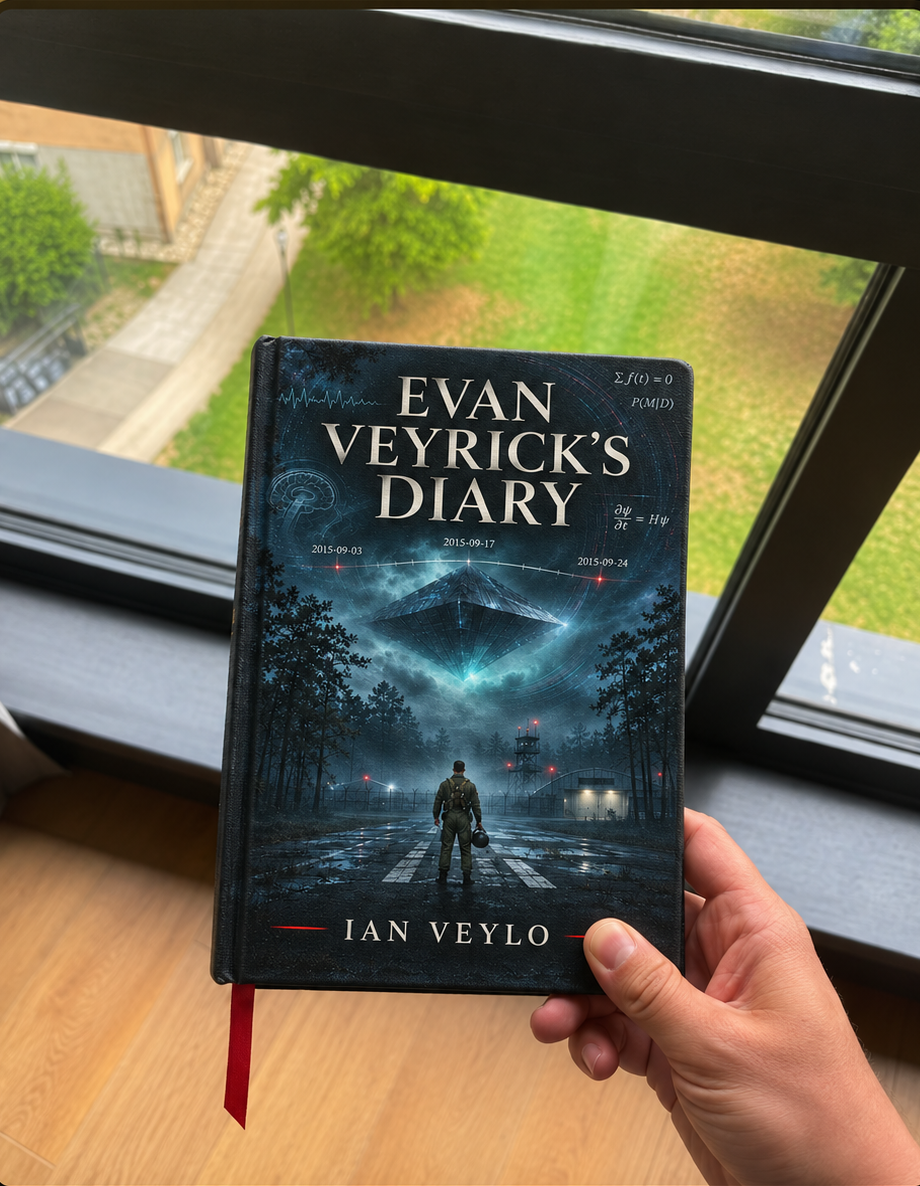
It's been several hours since I finished Evan Veyrick's Diary, and I genuinely don't know what to make of it.
Read full post
I've read plenty of mystery novels, psychological thrillers, and conspiracy fiction over the years. Most of them follow a familiar formula. Someone disappears, a secret is uncovered, and eventually the author explains everything.
This book was different.
Not necessarily because of what it revealed, but because of the questions it left behind.
And some of those questions are surprisingly difficult to forget.
The story revolves around Captain Evan Veyrick, a pilot stationed at Black Ridge Air Station in Northeast Texas, whose disappearance becomes a mystery that remains unresolved for years.
Then there's Ian Veylo, a detective whose investigation into Evan's disappearance leads nowhere.
Until an ordinary trip to find dining chairs for his sister takes an unexpected turn.
Ian gets lost, comes across a yard sale, and encounters an elderly woman who refuses to give him directions unless he buys a book.
It sounds ridiculous, I know.
But that's what makes Ian's story so unsettling. Something as insignificant as taking a wrong turn eventually leads him to a diary belonging to the very man whose disappearance he had investigated.
And what he discovers inside is far more disturbing than an explanation of a missing pilot.
I initially expected a conventional conspiracy thriller involving the military, secret experiments, and perhaps some classified government operation.
But the deeper I got into Evan's writings, the more I realized that his disappearance was only the surface of something much larger.
There's a mysterious system called ASTER.
I'm deliberately not going to explain everything about it, because discovering what ASTER is and what it may be capable of is one of the most interesting parts of the book.
But imagine discovering that certain events could be predicted before they happen.
Imagine questioning whether some of your memories actually belong to you.
Imagine experiencing déjà vu and wondering whether it's simply a strange neurological phenomenon or evidence of something you don't understand.
Now imagine someone possessing technology that could potentially exploit those things.
That's the kind of territory this book explores.
And what disturbed me most wasn't the technology itself.
It was the possibility of losing the ability to distinguish between your own decisions and decisions someone else wanted you to make.
One of the most fascinating aspects of the diary is the way Evan questions things most people never give a second thought.
Memory. Perception. Human behavior. Patterns. Obedience.
The author doesn't simply present a mystery and ask you to solve it. He gradually makes you question the reliability of the very tools you use to understand a mystery in the first place.
How can you trust your memories if memories can be altered?
How can you trust a prediction if knowing about it changes how you behave?
And how can you recognize manipulation if you've never known anything different?
I had to put the book down several times just to think about those questions.
There's also something deeply uncomfortable about Evan as a character.
He doesn't always know what's happening to him.
He tries to document what he experiences, compare his memories against evidence, and separate what he knows from what he merely believes.
That makes his account feel strangely human.
He's not some all-knowing protagonist who suddenly understands the secrets of the universe.
He's a man trying to establish what is real while the world around him becomes increasingly difficult to explain.
And that uncertainty follows you through the entire story.
The chapters dealing with disappearing people, memory manipulation, the frequency illusion, mental programming, and the possibility of predicting human behavior were particularly interesting to me.
Not because I believe every idea explored in the novel.
It's fiction, after all.
But because some of the psychological phenomena it references are real subjects of study, while the fictional possibilities built around them are disturbing enough to make you think.
There's a difference between believing a conspiracy and being fascinated by the question that inspired it.
This book understands that difference.
What really stayed with me, though, was the recurring idea of control.
How much of our behavior is genuinely independent?
How often do we mistake familiarity for truth?
How easily can people be persuaded to accept something simply because everyone around them accepts it?
At first, these questions seem philosophical.
Then the story introduces the possibility that someone might have discovered ways to turn those vulnerabilities into instruments of control.
And suddenly they don't seem quite so abstract anymore.
The most unsettling part is that the novel doesn't need to convince you that its fictional technology exists.
It only needs to convince you that the human weaknesses it could exploit are worth thinking about.
By the time I reached the sections exploring obedience, civilization, and the possible fate of the world, the original mystery surrounding Evan's disappearance had taken on an entirely different meaning.
I no longer found myself asking only what happened to Evan Veyrick.
I was asking why his account might be dangerous to someone who wanted it forgotten.
And that brings me back to Ian Veylo.
Because somewhere in all of this is a detective who was simply looking for furniture.
He didn't go searching for forbidden knowledge.
He didn't set out to expose a conspiracy.
He bought an old book at a yard sale.
And suddenly, a case that had remained unresolved for years was back in his hands.
Except this time, the information he possessed could put him in danger.
I think that's what makes the premise work so well.
It's the contrast between the ordinary and the extraordinary.
A wrong turn.
An elderly woman.
A cardboard box of books.
An old diary.
And a missing man's account of things that were never supposed to come to light.
I won't discuss the ending because I think it's better experienced without knowing what happens.
But I will say that the final part of the novel made me reconsider several things I'd read earlier.
Certain details that initially seemed insignificant suddenly felt more important.
And that sent me back through earlier chapters, looking for things I might have overlooked.
I still don't know whether every question the author raises is meant to have a definitive answer.
Maybe that's intentional.
Maybe some mysteries become less interesting the moment someone explains them completely.
What I do know is that I finished this book thinking about it as more than just a missing-person story.
It's a mystery about information, memory, perception, and the frightening possibility that understanding the truth doesn't necessarily mean you can do anything about it.
And perhaps that's what affected me most.
Because the scariest idea in this novel isn't that someone might be watching you.
It's that someone might understand you so well that they no longer need to.
I don't know how many people will come across Evan Veyrick's Diary.
But if you enjoy slow-burning mysteries, psychological suspense, strange coincidences, and stories that make you question what you think you know, this is one worth looking into.
Just don't expect a straightforward detective story.
What begins with the disappearance of a pilot becomes something much more complicated.
And what begins with a detective finding an old diary becomes a question that stays with you long after the final page:
If someone had the power to influence what you remember, what you believe, and what you choose, how would you ever know?
That's the question I keep coming back to.
And I think that's exactly what makes this story so unsettling.